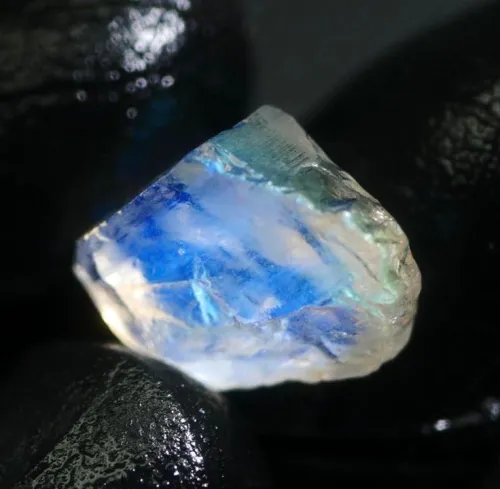
Moonstone can be found in specialty jewelry shops, reputable online gemstone retailers, and geological settings like igneous or metamorphic rocks, with significant deposits in Sri Lanka, India, Madagascar, and Brazil. Raw specimens are often available at rock and gem shows. Its unique optical effect, called adularescence, distinguishes it from other minerals.
Imagine scrolling through an online jewelry store late one night. A ring catches your eye – its milky surface seems to hold moving light, glowing like a captured moonbeam. But you pause, finger hovering over the "buy now" button. How can you trust a photo? Is this real moonstone, and where does this magical stone even come from? Later, while helping a relative sort old jewelry, you find a softly shimmering pendant. “That’s moonstone,” they say, “Grandma’s favorite.” Suddenly, you’re not just curious about buying it – you want to understand its sources, how to spot genuine stones, how geology forms this enchanting glow, and why some pieces feel timeless while others seem… questionable. Where *does* moonstone hide in the world, and how can someone recognize the real thing amidst look-alikes?
1. What exactly makes moonstone glow?
2. How does geology create moonstone deposits?
3. Where are prime locations to find natural moonstone?
4. What signs confirm genuine moonstone versus imitations?
5. Why does origin information affect ethical sourcing?
6. How should this gem be handled long-term?
Specialty gem vendors and geology-focused venues are primary access points. For natural moonstone, you're looking at retailers with origin documentation, rock & gem exhibitions where miners display specimens, or travel to specific geological regions known for deposits.
Picture this: you're walking through a gem show, rows of stalls glittering under bright lights. One vendor holds up a rough, lumpy white crystal pointing to inner flashes. “Sri Lankan moonstone,” they explain, “straight from the source.” This illustrates that beyond polished jewelry, moonstone exists as raw mineral specimens, often sourced directly from known deposits. Sri Lanka supplies stones renowned for bluest adularescence. Indian material tends toward warm peach tones, while Madagascar yields diverse colors. Geologically, pegmatite veins in metamorphic terrains act like natural stone factories. Crucially, reputable sellers detail mining origins because locality information can inform quality expectations and ethical considerations. As a practical step, requesting origin documentation adds a layer of verification when purchasing.
Moonstone's signature luminosity, adularescence, results from light diffraction within its layered structure. This floating light appears due to scientific interactions at the microscopic level, not mysticism.
A friend of yours once described her moonstone bracelet changing its glow under café lighting – a cool blue sheen shifting across the surface as her wrist moved. This phenomenon occurs due to stacked microscopic layers inside the stone. Light enters and bounces between these alternating layers of orthoclase and albite feldspar minerals, scattering wavelengths differently across the stone’s curvature. Think of it like thousands of tiny mirrors scattering light, creating that elusive, direction-dependent glow. This isn’t surface reflection; it’s an internal dance of physics. Blue adularescence is rarest because it depends on exceptionally uniform layering combined with trace minerals. Stones may appear white, gray, peach, or green in body color, but the interplay between this base color and layer chemistry creates the visual magic that has captivated people for centuries.
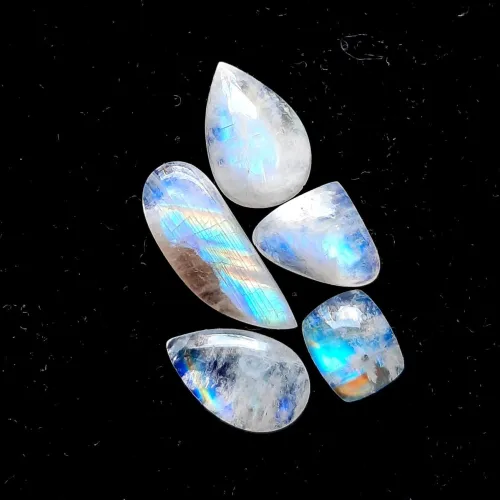
Moonstone forms when specific feldspar minerals cool slowly under precise geological conditions. These combinations occur in particular rock types and global locations over millions of years.
Imagine your hiking partner gesturing towards a granite outcrop during a trek, saying, "Pressure and heat interacted here for ages – perfect moonstone formation potential." This gem originates deep in Earth’s crust where molten rock containing abundant potassium, sodium, and aluminum cools exceptionally slowly. This slow cooling in pegmatites or metamorphic environments allows orthoclase and albite feldspar to separate into microscopic, alternating layers – the prerequisite for adularescence. Disrupt this delicate process (rapid cooling, insufficient potassium/sodium ratio), and you get ordinary feldspar without the glow. Key facts emerge here: Moonstone ranks 6–6.5 on Mohs scale, meaning it’s softer than quartz but forms distinctive tabular crystals within host rocks. Locations providing these ideal geological recipes include ancient mountain belts (like the Himalayas) and mineral-rich pegmatite fields.
Real moonstone exhibits specific optical phenomena, texture qualities, and wear patterns distinct from synthetic alternatives or imitations like opalite glass.
Recall browsing a bustling gem market stall. A vendor eagerly pushes a shimmering cabochon toward you, declaring it "premium moonstone." Yet beneath the fluorescent lights, its color bands seem unnaturally uniform. Here’s what to observe: Genuine moonstone shows directional sheen – tilt or rotate it slowly, observing how the light moves across the dome. Synthetic pieces often show static sparkle. Next, texture: run your fingertip over the polished surface. A smooth, uninterrupted curve without rough patches hints at skilled cutting respecting the stone’s fragility. Glass imitations feel 'sharper' optically.
Moonstone’s value connects to origin transparency, the intensity of its blue sheen, craftsmanship, and seller’s ethical disclosure practices.
Think back to that heirloom necklace – its journey matters. Responsible sellers provide information: Was it ethically mined? How far has it traveled? Sri Lankan material often commands higher values due to superior bluish adularescence, while Indian or Brazilian stones exhibit unique regional palettes. Cutting quality dramatically influences beauty and thus worth. A poorly cut cabochon sacrifices the stone's inner glow. Watch for disclosure statements about heat treatment—some stones undergo clarity enhancement to reduce internal flaws. Crucially, avoid ultrasonic cleaners due to fracture risk per practical tips, confirming fragility requires thoughtful care.
Finding moonstone extends past acquisition to proper maintenance, recognizing rare variants like rainbow or cat’s eye types, and understanding lab-created alternatives.
You finally decided on that ring. Now what? Sunlight exposure presents risk – prolonged UV light can gradually fade sensitive stones. Storage matters: avoid knocking it against harder gems in your jewelry box. Beyond classic white moonstone, rare varieties exist. Rainbow moonstone displays spectral flashes caused by internal fractures scattering light, while chatoyant moonstone produces sharp bands like a cat’s eye. For those wanting the look sustainably, high-quality synthetic moonstone ethically replicates the gem’s optical properties. Remember, cleaning remains essential: gentle washing with mild soap and microfiber, as noted in experience signals, preserves its luminous charm.
Before you next evaluate a moonstone, consider these three concrete principles blending location awareness, trust signals, and practical care.
If you're browsing for moonstone jewelry, pause and implement this final mini-checklist. Firstly: Verify origin details. Sellers truly familiar with moonstone discuss geology details – Sri Lanka's famed blue sheen? India's warmer glow? Lack of origin disclosure deserves questioning. Secondly: Test under light. Slow rotation should evoke that signature dance of light – a moving glow indicates authentic adularescence, distinguishing genuine mineral physics from cheaper sparkle. Static flashes raise warning flags. Thirdly: Account for softness. Whether it’s setting selection (bezels protect best) or cleaning solutions (avoid harsh chemicals), moonstone’s relatively low hardness requires gentleness. Carry these into your next jewelry store visit, online browsing session, or gem show exploration.
Moonstones weave through human stories – heirlooms passed down, gifts chosen thoughtfully. That makes practical awareness more meaningful, not less.
Perhaps it’s your partner’s birthstone, that antique brooch from a beloved relative, or the landscape you once hiked where minerals formed deep below you. If this journey into moonstone’s origins illuminates anything, it’s that recognizing real value requires looking beyond surface sparkle toward substance. Next time you see that floating light locked in stone, you might ask: What geology created this glow? What expertise ensured it was cut to showcase that inner play of light? What care will preserve its story? Not as mystical signs, but as connections linking earth science to human artistry and appreciation.
Q: Can you find moonstone in U.S. locations?
A: Yes, though less commercially significant than Sri Lankan deposits. Specimen-grade moonstone can be found in Virginia, Pennsylvania, and North Carolina, formed within local pegmatites.
Q: Why does some moonstone lack blue adularescence?
A: Blue sheen requires exceptionally consistent mineral layering thickness interacting with specific light wavelengths. Stones may display white sheen instead due to varying formation conditions.
Q: How to store moonstone jewelry long term?
A: Wrap it inside soft cloth in a dedicated compartment away from harder stones. Its moderate hardness means avoiding physical impact is key, alongside keeping it away from harsh cleaning agents.


$
