Moonstone exhibits a range of colors, most commonly pearly white, gray, or peach with a distinctive blue or white sheen called adularescence. Its base color varies from colorless to white, gray, green, orange, or brown due to mineral composition, while light interference within its feldspar structure creates an ethereal glow that appears to move across the stone's surface.
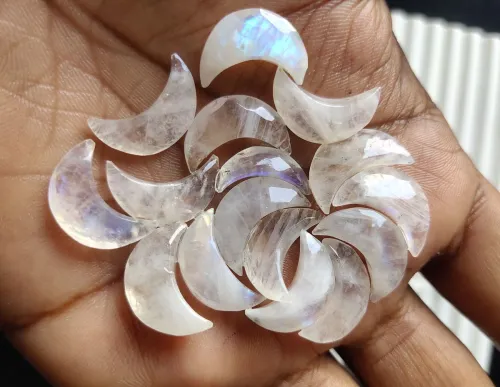
Imagine you're turning a moonstone ring in a jewelry store, noticing flashes of blue turning silvery as the stone catches different angles. This shifting display leaves you wondering: which color defines this gem? Or picture unpacking an online purchase expecting vivid blues only to find a milky stone with faint glows. These moments spark endless questions about what truly characterizes moonstone's palette and what visual clues matter most during selection. Beyond the initial "what color" wonder, you're likely pondering why the glow appears and disappears, what causes value differences in seemingly similar stones, or how lighting conditions alter its personality.
Why does moonstone's glow shift with movement?
What causes different base colors in moonstones?
How does light create the signature blue glow?
What determines a moonstone's value based on color?
Can lighting change how moonstone appears?
How to differentiate natural variations from imitations?

Moonstone's color experience changes dynamically depending on movement and viewing angle because its structural layers interact with light directionally. This explains why you might see intense blues one moment and nothing the next while examining jewelry in stores.
Picture holding your friend's heirloom moonstone necklace near a window: as sunlight catches it, a glowing band glides across the surface like moonlight on water when tilted. This spectacle happens because albite mineral layers within moonstone—each thinner than a wavelength of light—split and reflect rays like tiny prisms. The angle-dependent sheen you witness serves as a key authenticity signal; synthetic versions often lack this natural light dance. For the strongest effect, slowly rotate stones under focused light while watching how the glow responds to position changes.
Adularescence—moonstone's signature glow—comes from light diffraction between stacked mineral sheets measured in nanometers, not chemical coloring agents. This optical phenomenon creates an illusion of color from structure rather than pigmentation.
A friend of yours once photographed her "blue" moonstone ring indoors but noticed the glow disappeared in her pictures. This happens because the precise 150-300 nanometer thickness of albite micro-layers acts like light diffraction filters: when aligned uniformly like venetian blinds, they isolate blue light wavelengths best. Picture those layers as transparent films stacked at scientific precision; thinner units (150-300nm) diffract blues like India's prized specimens, while irregular or thicker ones scatter white light. Stone cutters actually orient cabochons perpendicular to these layers to maximize the floating effect shoppers later admire.
True moonstone’s adularescence only displays blue-to-white sheens, while "rainbow" versions are usually labradorite with different mineral composition showing multi-color flashes. Base colors range widely from pure colorless to brown depending on microscopic mineral guests within the feldspar.
While comparing two supposedly identical "white" moonstones at a collector's meetup, you notice one radiates vivid blues while the other shows barely any glow. What explains the difference? Stones from India typically have the thin albite layering that favors clear blue sheens, while Sri Lankan specimens often produce foggy whites from thicker mineral separations. Peach and gray undertones come from hematite or goethite inclusions trapped during formation—picture them as natural tint filters within the stone. Milky appearances can signal either microscopic feldspar mixtures creating haze or thick light-diffusing layers.
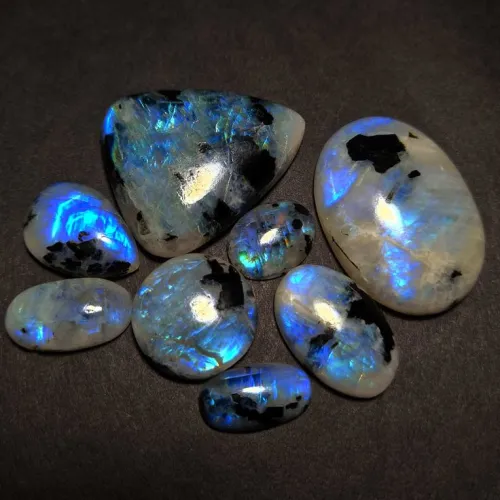
Natural moonstones always show minor color zoning, temperature sensitivity that slightly changes clarity, and surface vulnerability – all characteristics typically absent in synthetic alternatives or outright fakes.
Your grandmother's necklace appears almost crystalline by candlelight yet faintly cloudy in daylight? Such slight transparency shifts occur because moonstone expands microscopically with warmth, altering light passage that reveals inclusions. Authentic pieces typically display body color zoning—uneven peach or gray patches visible against white backgrounds. Check for natural imperfections: hold pieces near a lamp to spot subtle milkiness from trapped fluids or minerals, visible as misty veils rather than factory-perfect uniformity. Jewelers prioritize blue-directional adularescence and transparency since clean three-dimensional glows remain rare compared to milky whites.
Understanding moonstone's light-interaction fundamentals helps manage expectations for daily wear while selecting pieces maximizing visual impact. Blue sheens generally signal structural idealization worth protective settings, while subtle warmth in peach varieties requires specific lighting conditions.
Recall that moment unpacking a disappointing online purchase: you can avoid repeats by deliberately viewing stones under both daylight and LEDs before deciding. Remember how rotated angles change perception? Next time you see moonstone jewelry, consciously watch for directional sheens and slight color zoning—these details separate nature’s artwork from simulations. What observations would matter most if that ring display case held something meant for your collection?
Where does blue moonstone form naturally?
Blue sheen moonstones primarily occur in Southern India, where geological conditions create ideal albite layer thickness for diffraction. These deposits remain the global standard for vivid directional blues despite discoveries in Myanmar and Tanzania.
Can moonstone have yellow or orange undertones?
Warm peach-to-orange body colors may develop from iron oxide (hematite) inclusions, often appearing in Madagascan specimens. These stones display less valued white adularescence rather than coveted blues.
How valuable is gray moonstone compared to blue?
Gray-base stones with intense blue adularescence rank highest commercially, while solid gray pieces without glow carry significantly lower valuations due to abundant sources. Transparency and sheen quality ultimately outweigh base color.
Does moonstone change color permanently over time?
Structural integrity prevents permanent shade changes, though scratches may create visible abrasions that scatter light. Proper storage helps maintain clarity since long term friction can cloud surfaces.


$
