Moonstone typically displays a blue-to-white pearly sheen called adularescence, though its base color can range from colorless to white, gray, brown, peach, or yellow. This optical effect creates a moon-like glow caused by light diffraction within layered feldspar minerals.
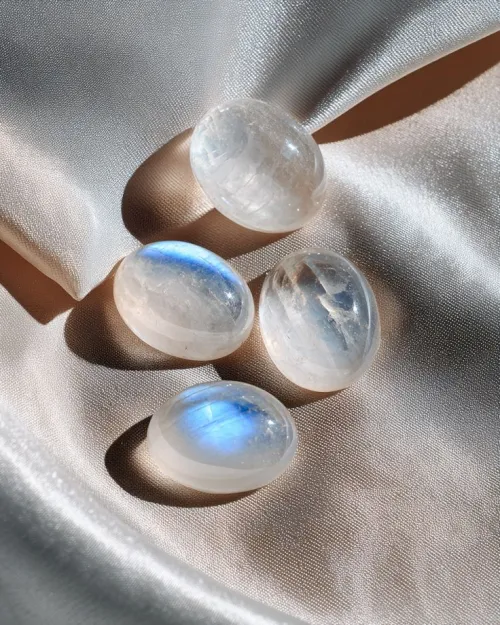
Imagine opening a package containing a 'blue moonstone' pendant bought online, only to find it looks disappointingly clear under your kitchen lights—until sunlight hits it and reveals that phantom glow. Or picture inheriting grandmother's antique brooch with a milky stone that seems to hold captured moonlight when tilted. When jewelers at gem fairs price similar-looking whitish stones wildly differently, you start wondering what truly defines moonstone's color. Beyond these everyday puzzles lie deeper questions about light physics and mineral science that affect how we perceive—and value—this enigmatic gem.
What exactly creates moonstone's signature glow?
Why does the same stone appear different under various lights?
How do mineral structures influence observed hues?
Can you distinguish quality indicators at a glance?
What practical factors affect its appearance in jewelry?
Beyond color, what essential characteristics matter?
Moonstone isn't defined by one static color but by its shifting interaction with light. Its core appearance combines a base body color with a floating optical effect.
A friend once showed me a pendant inherited from their grandfather—milky-white indoors, but blooming with waves of blue when moved near a window. This transformation happens because moonstone belongs to the feldspar mineral group where light diffraction between alternating mineral layers creates adularescence. While the base color provides the canvas, it's this gliding sheen that defines moonstone's visual identity. In jewelry contexts, the optical play can override the base color perception entirely, especially in thinner cabochon cuts that maximize light interaction.
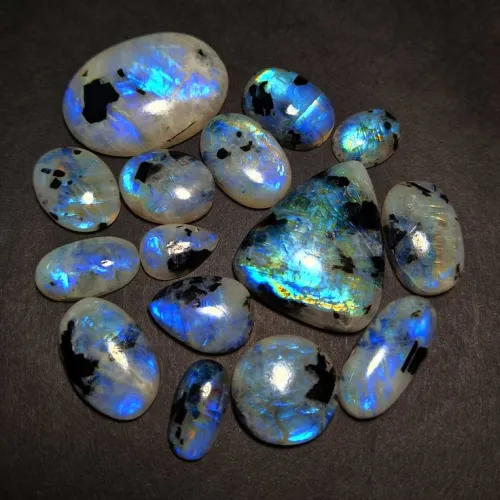
Moonstone's appearance dramatically shifts based on lighting conditions and observation angles, often causing confusion for owners.
Picture this: you're at a jewelry store debating between two moonstone rings—one looks vividly blue under spotlights, the other appears milky-white. Fast forward to daytime, their appearances reverse completely. This isn't inconsistency but science at work. Genuine blue adularescence may vanish/reappear dramatically with angle shifts due to the precision required in the mineral layers to diffract blue wavelengths. Technical_features underlying this include: mineral layer thickness (thinner layers yield blue, thicker ones white), light wavelength interactions, and the cabochon dome curvature. A gemologist once pointed out that milky over transparent stones often deliver stronger 'floating light' effects because internal structures scatter light differently.
Observing these visual cues helps distinguish natural traits:
The phenomenon occurs due to light diffraction between microscopic orthoclase and albite feldspar layers.
Picture stacking thousands of transparent films thinner than paper—when light hits this layered structure, it scatters into spectral colors. In moonstone, thinner mineral layers specifically diffract blue wavelengths, while thicker layers produce white light dispersion. Geological formation in pegmatite rocks allows these precise altrenating-layer structures during cooling. When a cutter shapes the stone into a curved cabochon, they're not creating beauty but revealing what already exists: the dome shape angles the layers to create maximum interplay with passing light. Value increases with transparency, blue intensity, and sheen coverage since these indicate optimal layer alignment.
Beyond light, cut quality, mineral composition, and viewing perspective determine what color manifests.
Consider two buyers examining seemingly identical moonstones. One pays premium for a Sri Lankan specimen showing blue across 60% of its surface; the other saves on an Indian rainbow variety with colorful flashes. Both choices make sense because origin affects typical layer patterns—Sri Lanka produces prized thin-layer blue specimens, while India yields thicker-layer variety. Now imagine the stones cut differently: a master-crafted dome will distribute sheen evenly, while asymmetrical domes create patchy effects. As my gem-hunter friend notes: "Assess dome symmetry first—poorly cut cabochons handicap even exceptional material." When evaluating stones, angle-dependence means kneeling or tilting creates entirely new observations.
Recognize natural moonstone through systematic observation of sheen behavior and physical characteristics.
A mineral dealer showed me how stress fractures under magnification explain why one piece survives daily wear while another chips. Because moonstone ranks 6-6.5 on the Mohs hardness scale and has cleavage planes, durability concerns are real. When comparing specimens, check not just blue intensity but coverage—stones showing consistent sheen across 50%+ surface command premiums. View edge-on under a bright lamp: distinct banding suggests natural lamellar structures supporting adularescence. Be aware: rainbow moonstone is technically labradorite but accepted commercially. Practical factors matter too—consider milky stones for strong "floating light" or store separately to prevent scratches from harder gems in jewelry boxes.
Next time you're evaluating:
Geological formation, historical context, and practical usage considerations complete your understanding.
That dusty brooch box in thrift stores? Many contain moonstones mistaken for cheap glass due to surface degradation from decades of improper cleaning. Historically termed hecatolite or Ceylon opal, moonstone carries legacy even as an alternate July birthstone. Formed in cooling pegmatite rocks through igneous processes, its durability informs wearability. While fine specimens can reach transparency grades, most commercial stones show characteristic milky inclusions. Now knowing that impact vulnerability comes from mineral cleavage, you'll understand why ring settings require protective designs. Investment value favors Sri Lankan blue specimens with high transparency and uniform sheen.
Moonstone appreciation requires shifting your observation habits to catch details most shoppers miss.
The next time you're in a jewelry store or browsing gems, pause and experiment. Rotate that cabochon under store lighting—see how the sheen slides? Bend your knees slightly and notice colors shifting. Compare indoor and window-light appearances. This simple repositioning reveals what casual observers overlook. Remember: what seems like inconsistency is nature's precision at work. If you're evaluating purchases, prioritize three key checks we've explored: dome symmetry for light distribution, sheen mobility rather than static reflections, and structural integrity at the stone's edge. True mastery isn't memorizing facts but training your eye with natural curiosity.
Is rainbow moonstone actually moonstone?
No—it's technically a trade name for labradorite with similar optical effects, though commonly sold as moonstone.
Can moonstone be worn in everyday rings?
Possible with protective settings and mindful wear, but its 6-6.5 hardness may lead to scratching or chipping over time.
How to pronounce moonstone?
Pronounced as [MOON-stohn], with emphasis on "moon" like Earth's natural satellite.


$
