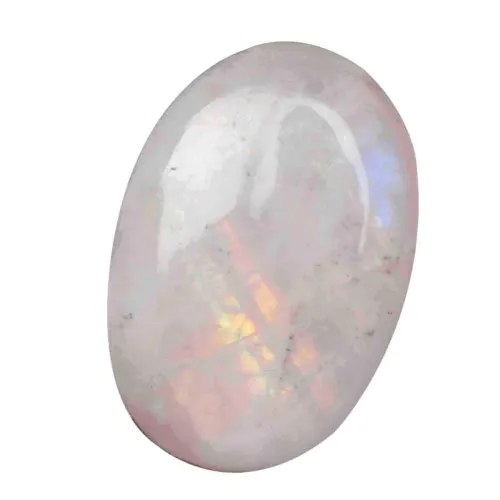
Moonstone typically appears as a milky, translucent to semi-transparent gemstone displaying adularescence – a distinctive glowing sheen that glides across its surface when moved under light. Its base colors range from colorless to white, gray, peach, or green, with high-quality stones exhibiting vibrant blue sheens. Some specimens may showcase rare optical effects like cat's eye phenomena or rainbow flashes depending on their structure and cutting.
Imagine unboxing a moonstone pendant you ordered online. That milky gem with floating light isn't broken – it's precisely what natural moonstone should look like, though the intensity varies. Or perhaps you're admiring a family brooch when the peachy stone inside mysteriously glows blue as it catches lamplight. Moments like these spark questions far beyond "Is this normal?" – you find yourself wondering why light dances beneath the surface, how to distinguish true moonstone from lookalikes, or whether a stone's cloudiness indicates poor quality. These everyday encounters reveal key visual surprises: moonstones look drastically different under various lights, genuine gems never show perfectly uniform colors, and that distinctive shimmer behaves like captured moonlight sliding across water. Throughout our exploration, we'll untangle these puzzles through jewelers' observations and geological insights.
1. What are the essential visual traits of genuine moonstone?
2. Why does moonstone glow when tilted in light?
3. How do origins and cutting quality affect appearance differences?
4. What separates real moonstone from convincing fakes?
5. How does moonstone's appearance compare to similar gems?
6. Which visual cues indicate higher quality or value?
Authentic moonstone presents a soft, milky base with a floating light effect that moves across its curved surface during rotation. Expect translucency rather than clear transparency – shadows diffuse through the material like sunlight through morning fog. Base colors range widely: from whitish-silver to peach, green or gray, often showing subtle undertones. The signature glow (adularescence) typically appears blue or white, concentrated at specific angles.
Picture yourself examining a moonstone ring in a dimly lit cafe. The stone might first look like frosted glass until you turn your wrist – suddenly, a blue haze glides sideways. A friend across the table notices this ghostly light shift and asks why yours behaves differently from their own moonstone bracelet. Your explanation lies in fundamental mineral traits: the semi-transparent "milky" appearance comes from countless microscopic layers within the feldspar mineral family. These stacked structures scatter light instead of letting it pass cleanly. Adularescence occurs because light bounces between these alternating layers, creating interference that our eyes perceive as that ethereal glow. Genuine stones almost always show some internal textures – perhaps wispy inclusions resembling fingerprints or crystalline stress lines resembling cobwebs. Value often correlates with the intensity and area of that elusive blue glow rather than perfect clarity.
Moonstone's signature glow happens because its layered structure redirects light internally before reflecting it outward. The phenomenon depends entirely on interaction between the gem and light sources, disappearing without proper illumination angles. Material from different locations may exhibit unique glow behaviors due to geological conditions during formation.
A friend once puzzled over why her grandmother’s moonstone earrings only shone intensely under store spotlights, appearing duller at home. This perfectly demonstrates adularescence physics – but let’s translate the science into everyday understanding. Imagine moonstone’s structure as thousands of transparent paper sheets stacked together, each with slightly different thickness. When light enters, some beams refract immediately off the first layer while others penetrate deeper before reflecting back. These staggered reflections interfere with each other, amplifying specific wavelengths that we see as that distinctive blue or white glow. Factors like layer thickness, uniformity, and mineral composition influence what you observe:
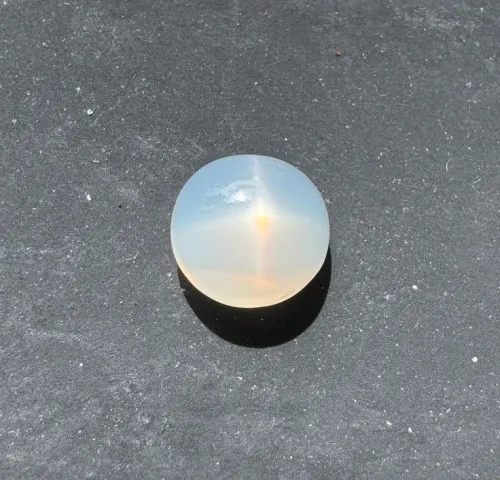
Geographic origin, cutting quality, and natural flaws create observable appearance variations across moonstones. Indian stones often show multicolor flashes against bluish backgrounds, while Sri Lankan specimens typically prioritize clean blue sheens against paler bases. Cutting orientation significantly impacts glow area and movement, with asymmetrical doming potentially shifting the light effect toward edges.
Imagine comparing two sellers' "rainbow moonstone" beads at a craft fair. Vendor A displays stones exploding with blue-white radiance across their entire surface, while Vendor B's pieces shimmer only along the perimeter with minimal color play. These differences trace back to three factors: geological origin determines mineral composition thickness, cutter expertise guides precision shaping, and natural inclusions create visual texture variations. Madagascar moonstones frequently showcase brighter transparency with distinctive inclusions resembling rain droplets. Brazilian material might appear thicker and milkier. Cutting matters equally – shallow cabochons fail to capture glow properly because their flat profiles minimize light interactions, while overly tall domes concentrate light awkwardly. Skilled lapidaries shape moonstones so the adularescence floats across optimal surface areas. Natural stresses within uncut stones create "centipedes" – intricate crack systems that become focal points reflecting light differently.
Authentic moonstone exhibits three core visual signatures: direction-sensitive adularescence creating "gliding light," semi-translucent internal textures rather than glassy clarity, and subtle irregularities like fingerprint-like inclusions or natural fissures that disrupt the glow inconsistently. Synthetic substitutes appear unnaturally uniform or display optical effects inconsistently.
Recall that jewelry store scene where you simultaneously held two supposedly identical moonstone rings – yet one radiated dreamy light while the other stared blankly as polished plastic. Identifying authentic specimens relies on specific observation tactics:
While blue adularescence generally indicates higher quality, other factors like glow coverage area, uniformity, and absence of dark inclusions better determine overall worth than body color alone. Moonstone differs from opal through its predictable floating sheen rather than unpredictable color flashes, plus greater transparency despite their visual similarities at first glance.
That heirloom brooch under your late-afternoon lamp exemplifies why moonstone appreciation extends beyond first impressions – as you tilt it slowly, initial disappointment about mild surface scratches gives way to fascination as the glow intensifies at specific angles. Value perception evolves through repeated observations: durable moonstones with minor surface wear generally maintain optical integrity while structurally compromised pieces appear increasingly cloudy. When comparing stones, prioritize gems showing adularescence across over 60% of their surface area during rotation rather than those with perfect transparency and weak glow. Unlike more fragile opals needing hydration controls, untreated moonstone maintains stable appearance through moderate wear conditions, though it chips easily alongside harder stones. Proper storage prevents abrasion while thoughtful cleaning preserves that light-play magic – always gently wipe with plain water instead of harsh chemicals.
Keep three core principles in mind during future moonstone encounters: Always inspect under natural daylight to accurately judge adularescence quality; recognize that directional blue glow outweighs body clarity for valuation; handle cabochons carefully at the edges due to structural vulnerability. Store pieces separately to prevent surface abrasions that mimic cloudiness.
Next time you encounter moonstone – whether in store windows, inherited jewelry, or online listings – transform ordinary moments into opportunities for appreciation: Pause before purchasing to ask "How extensive does that blue magic move across the dome?" instead of focusing solely on listings promising exaggerated rainbow effects. If handling a jewelry piece, gently rotate it against a window noticing exactly where the glow blooms brightest. And whenever uncertainty strikes about authenticity or quality, recall that natural moonstone reveals its story progressively through movement and light interaction rather than immediately apparent perfection. Consider photographing potential purchases at various angles using natural lighting. Should doubts arise later, revisit these observable checks rather than relying on vague mysticism claims. What specific feature would you examine first tomorrow when faced with an unfamiliar moonstone?
Q: What does natural moonstone look like versus fake?
A: Genuine pieces show moving light effects that appear internal rather surface-level, natural imperfections like stress fractures, and soft color transitions. Common glass fakes display sharp reflections visible anywhere plus bubbles or swirls unnatural to moonstone.
Q: Why does my moonstone look cloudy and not shiny?
A: Cloudiness may result from abrasion damage accumulated during wear, suboptimal cutting angles affecting light paths, lower-grade material with poor light transmission, or improper ultrasonic cleaning having fractured layers internally. Some naturally included specimens also limit transparency.
Q: What's the difference between moonstone and opal visually?
A: Moonstone typically displays broad-area phenomena like soft glowing sheets shifting within lighter-hued transparent bodies, while opal usually shows densely packed pinpoints or patches flashing different rainbow colors erratically across opaque or dark backgrounds.
Q: Which color moonstone is most valuable?
A: Blue sheen concentration often correlates with higher worth compared to equally transparent stones without such color play. Particularly sought-after specimens exhibit rich cornflower-blue adularescence covering over half the surface when rotated under light.
Q: Does moonstone scratch easily?
A: Ranking 6-6.5 on the Mohs scale, moonstone can sustain scuffs from dust/debris carrying harder minerals over time. Proper storage helps avoid abrasions that compromise surface polish integrity, which would diminish light performance.


$
