Yes, moonstone is a crystal. It's a variety of orthoclase feldspar with a distinct monoclinic crystal structure formed through geological processes. The characteristic blue glow known as adularescence occurs through light diffraction between microscopic crystalline layers.
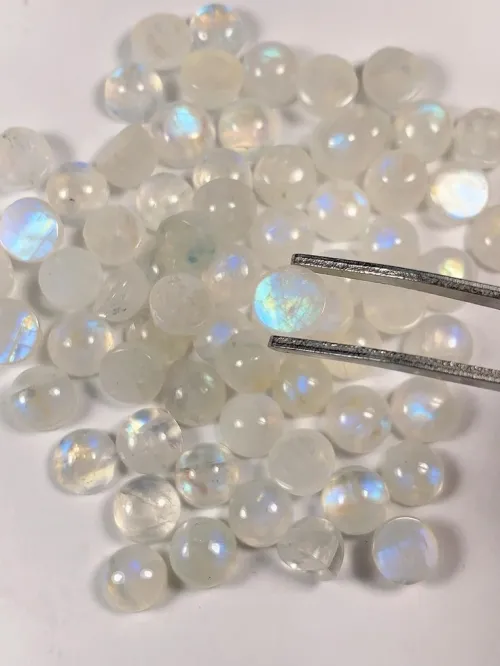
Imagine you've just unboxed an online jewelry purchase – a ring advertised as featuring "authentic moonstone crystals." You tilt it toward the lamp, watching the ghostly blue light dance across its surface. Is this truly a crystal like quartz or granite, or merely a trade name for pretty glass? Or picture your grandmother's heirloom necklace in your palm, catching afternoon light through its milky depths. You recall how she called it her "moon crystal" but wonder if old jewelry terms match modern mineralogy. When a friend dismisses moonstone as "just polished rock," while its play-of-light mirrors quartz specimens in science museums, the questions multiply. Beyond "is it a crystal," you likely wonder how to verify authenticity, why it exhibits such optical magic, and how to distinguish genuine moonstone from clever imitations.
How does moonstone form geologically to qualify as a crystal?
What observable features prove its crystalline structure?
Can I test moonstone authenticity using everyday methods?
Why does its glow differ from other crystals?
How should genuine moonstone be cared for?
Moonstone undeniably possesses a defined three-dimensional atomic arrangement meeting mineralogical crystal criteria. It's not amorphous glass or randomly aggregated rock. Rather, it belongs to the monoclinic crystal system within the feldspar group.
A friend once handed me an uncut moonstone sample during a geology walk. "This doesn't look like textbook crystals," they said, comparing its smooth surface to quartz's angular formations. That moment captures the disconnect – crystalline identity isn't about outward geometry but internal order. Moonstone's potassium-rich orthoclase composition develops measurable crystal planes detectable by X-ray diffraction. Under magnification, its microstructure reveals alternating albite/orthoclase layers responsible for the characteristic glow. This lamellar structure forms only through controlled volcanic crystallization under specific temperature-pressure gradients – a fingerprint of true crystalline formation absent in synthetic glass.
Three common situations make people unexpectedly question moonstone's crystalline status:
Online shoppers might doubt store descriptions calling glass-clear gems "moonstone crystals." Jewelry lovers testing inherited pieces often notice how moonlight-like sheens differ from crystal flash effects in quartz. Casual collectors debate mineral definitions over coffee when handling specimens resembling opal and quartz simultaneously.
Picture this: You're examining a pendant at a local craft fair. The vendor enthusiastically calls it "crystalline moonstone," but the stone feels suspiciously light. When tilted, its glow appears unnaturally uniform. Behind this moment lie critical observations – authentic moonstone's adularescence flows like liquid moonlight moving across the surface. Real crystals tend to feel denser than glass imitations due to the weight of their molecular structure. Similarly, when discussing jewelry with friends, someone once compared moonstone's texture to talc despite its measurable Mohs 6-6.5 hardness – this confusion stems from its perfect cleavage, a crystalline characteristic often mistaken for softness.
Moonstone births from magma crystallization processes over millions of years. Its unique glow forms from alternating mineral layers developing parallel crystal orientations during cooling.
Imagine hiking through Sri Lanka's highlands where miners trace pegmatite formations – ancient volcanic signatures pointing to prime locations. Liquid rock cools slowly underground, enabling potassium and sodium ions to arrange into orderly crystal lattices. Crucially, cooling rate determines gem quality: Ideal conditions allow orthoclase/albite layers to form at 0.01mm thickness to scatter blue wavelengths. Contrast this with obsidian formation – similar ingredients but rapid cooling creating disordered glass. Moonstone mines reveal this difference – excavated stones with visible banding show geological "growth rings" recording temperature changes during crystallization. That peachy variety? It contains traces of copper ions captured within crystalline structures during formation.
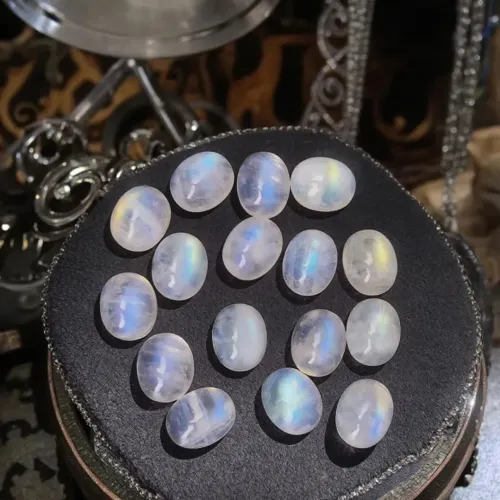
Authentic moonstone exhibits four empirically verifiable proof points of crystallinity:
Body color variations: Unlike synthetic uniformity, natural crystals show "milk-and-water" zones from mineral distribution variations.
Depth perception: Viewed closely, internal layers display 3D dimensionality impossible in glass or plastic.
Cleavage patterns: Accidental chips exhibit clean 90-degree cleavage angles revealing structural alignment.
Thermal reaction: Crystal lattices conduct heat efficiently – against your skin, moonstone feels initially cooler than synthetic equivalents.
When gem-shopping, observe how top dealers display pieces on dark velvet under angled lights. They're demonstrating adularescence – the glow swimming beneath the surface when you rotate the stone. This phenomenon requires crystalline structures scattering light in a specific manner. During a memorable market encounter, a vendor taught me to breathe gently on suspect stones. Authentic crystals clear condensation faster than glass due to differential thermal conductivity. Similarly, hold moonstone near printed text: Genuine specimens distort letters through subtle wave-like internal structures – light refracting between countless crystalline layers impossible to replicate synthetically.
Verification employs accessible observation before scientific confirmation.
The core method involves examining lighting reactions and surface properties. Adularescence must show directional movement rather than static sparkle, while surface flaws should evidence natural formation. This approach balances scientific proof with practical checking.
Start with direct light testing: Place the piece under bright white light (phone flashlights work). Authentic moonstone reveals mobile blue sheen crossing the surface like moonlight moving across water.
When assessing jewelry settings, examine bezels carefully. Genuine moonstone jewelry often leaves crystal surfaces somewhat exposed – cabochons showcase adularescence freely whereas synthetic stones might be encased to conceal unnatural edges.
Several nuanced factors determine moonstone's characteristics across formation environments.
Chemical composition determines appearance: Potassium-rich orthoclase creates classic white/peach specimens, while sodium influences blue varieties. Geographic origin matters – Sri Lankan mines produce fine blue-adularescence moonstones prized for clarity, while Indian sources yield denser whites. "Rainbow moonstone" isn't standard feldspar mineral but exhibits similar phenomena. Care requires attention: Despite its crystalline strength, moonstone cleaves easily and clouds with harsh chemical exposure.
Moonstone's magic lives in tangible moments illuminated by understanding its crystal identity. When encountering these stones, shift focus toward observable evidence.
Recall our jewelry-shopper's unboxing uncertainty: Next time, they'll first rotate pieces under bright light to watch for the signature moving glow before scrutinizing sales claims. The heirloom keeper will examine grandmother's necklace edges for crystalline cleavage patterns revealing its geological history. And when someone calls moonstone "just a rock," you'll smile while sharing how its temperature-conducting properties or adularescent depths verify its mineralogical pedigree. The wonder isn't diminished by knowledge – it's enhanced. Notice three key details in future encounters: that liquid-like internal glow shifting with movement; the unexpected heaviness relative to glass; and those characteristic 90-degree crystalline cleavage planes visible on edges.
What distinguishes moonstone from quartz crystals chemically?
Moonstone belongs to the feldspar family (KAlSi₃O₈), while quartz is silicon dioxide (SiO₂). This composition difference creates its unique layering.
Can quality vary depending on origin?
Geography influences characteristics significantly. Sri Lankan moonstones often exhibit the brightest blue adularescence, while Indian stones may show stronger body colors.
Do artificial treatments affect crystallinity?
Treatments like surface coatings can manipulate appearance, but authentic stones retain natural internal crystalline structures that determine core properties.
Will proper maintenance preserve characteristics indefinitely?
Stored separately from harder gems and cleaned gently with mild soap, natural moonstone's adularescence may persist for generations despite surface changes from wear.


$
