Moonstone is a natural gem variety of the feldspar mineral group, primarily composed of orthoclase and albite arranged in microscopic alternating layers. This unique stacked structure scatters incoming light to produce its signature glowing effect called adularescence. It forms deep within the Earth's crust through the slow cooling of molten rock over millions of years.
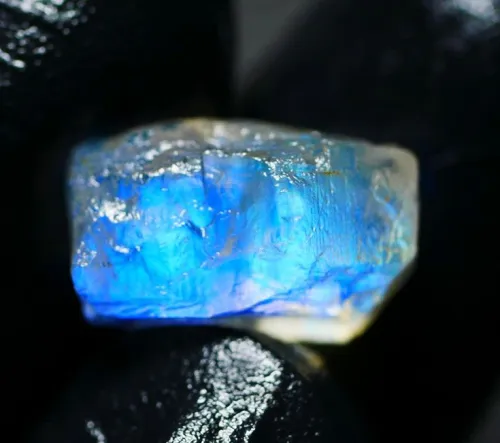
That moment when your online jewelry order finally arrives - you unpack the little velvet box, slide open the lid, and stare at your new moonstone ring. Under artificial kitchen lighting, the stone looks disappointingly flat and murky compared to the seller's dazzling flash-lit photos. Or perhaps you're at a bustling gem fair seeing three vendors proudly display "authentic moonstone" pieces - one pale white, one peachy-pink, and one with a watery blue shimmer - all claiming authenticity while looking nothing alike. Confusion bubbles up alongside fascination. These small human moments often spark questions beyond the surface: Why does its milky glow change in different lights? What gives each stone distinct character? How does something formed deep underground gain this ethereal appearance? Beyond those core curiosities, people often wonder about its durability, value factors, maintenance needs, and how this earthly stone earned its lunar name.
What exact minerals create moonstone and how do they interact?
Why do moonstones display that signature glow called adularescence?
What causes dramatic visual differences between two natural moonstones?
Which practical traits help identify genuine vs imitation stones?
How does moonstone's geological origin impact its appearance?
Can it handle daily wear in jewelry and what care does it require?
What explains its connection to the moon given its earthly origins?
Moonstone fundamentally consists of two specific feldspar minerals - potassium-rich orthoclase and sodium-rich albite - bonded in stacked microscopic layers. This distinct arrangement acts as light-scattering engine driving its visual magic. Together they crystallize at depths of 6-8 kilometers under immense heat and pressure.
Picture holding a newly inherited moonstone pendent. Its surface shows cloudy patches where the underlying layers aren't perfectly uniform - visible evidence of its mineral marriage. Feldspars comprise nearly 60% of Earth's crust, making moonstone's building blocks surprisingly common worldwide. Yet specific conditions must align: Albite and orthoclase intergrow during slow cooling in pegmatite formations. Trace elements like copper or manganese seep in to tint layers peach or blue. Tiny gaps or mineral inclusions within layer interfaces fracture light paths, creating milky patches. The technical_features? Alternating orthoclase-albite sheets averaging merely 500-5000 nanometers thick - a geological collaboration written in crystal.
Adularescence happens because light waves scatter upon hitting alternating mineral layers with differing refractive indices, concentrating into a directional glow. Its intensity peaks under sunlight rather than artificial lighting.
A friend hands you her cherished moonstone bracelet outdoors, gushing about its "inner light." As you rotate your wrist under noon sun, a blue shimmer glides silently across the stone's surface and vanishes. This observable phenomenon traces back directly to mineral physics: Sunlight contains full-spectrum waves hitting stacked orthoclase (refractive index 1.52) and albite (1.53) layers. Rays diffract where interfaces meet, bending paths and separating wavelengths. Blue waves scatter most readily, gathering at specific angles to create that moving sheen. Unlike flat sparkle, adularescence appears subsurface - seemingly floating like moonlight through fog. Technical_features? Interlayer diffraction causing wave interference patterns visible only when crystals align uniformly during formation.
Natural moonstones show substantial visual diversity - including varied body colors and adularescence strength - depending on mineral impurities, layer consistency, and optical properties. Imitations often look unrealistically consistent or display unnatural optical effects.
That chaotic gem fair visit replays in your mind: Vendor A's ivory oval showed a subtle white glow shifting lazily left to right. Vendor B's peachy cabochon had concentrated blue flashes firing like a signal lamp. Vendor C’s rainbow-bursting stone seemed suspiciously vibrant. How to navigate such variations?
Focus on how light interacts with inner structures. Genuine stones reveal geological fingerprints through distinct visual patterns.
Directional blue sheen: Rotate stone under direct light; high-quality specimens often concentrate glow in rolling waves
Uneven milky patches: Hold against white paper under backlight; natural layer inconsistencies may appear as blurry zones
Flat geometric reflections: Tilt slowly under lamplight; rigid flashes can signal engineered materials
Overly uniform sparkle: Examine under magnification; identical glitter frequency points to synthetic opalite glass
Rainbow color bursts: Notice diffraction angles; sharp spectral splits may suggest actual opal misidentification
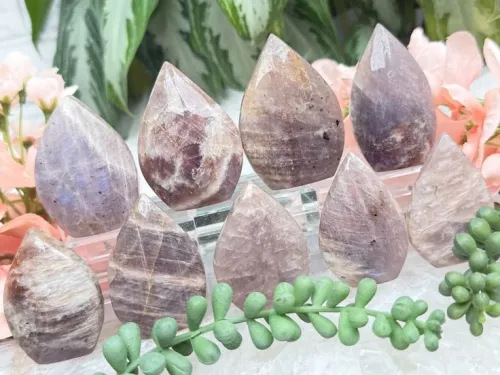
Verifying genuine moonstone involves observing layer-born adularescence, surface integrity, expected inclusions, and heft. Sri Lankan sources typically show strongest blue sheen due to geological conditions.
Imagine you're selecting stones from an online gallery. The vendor claims "Sri Lankan moonstone," but how to feel confident? Your home testing toolkit is simple but revealing: Place contenders against neutral gray paper to accurately judge inherent body color without interference. Weigh each stone gently in your palm - moonstone's density (2.56-2.59 g/cm³) feels reliably substantial compared to hollow plastic or lightweight glass. Take it outside - strong sunlight activates adularescence that weaker indoor bulbs often mask. If claiming Sri Lankan origin, does it show that famous concentrated blue glow when you rotate it under direct sun? Technical_features? Pegmatite formation chemistry under cooling stress creates favorable alignments.
With a Mohs hardness of 6-6.5 and perfect cleavage planes, moonstone requires protective settings and gentle cleaning to maintain its appearance. Years of wear may slowly dull surfaces.
Remember that inherited pendant growing less luminous over decades? No metaphysical energy faded - physics explains it. Skin oils build up microscopically within surface-reaching cleavage lines where light once entered cleanly. Accidental knocks chip crystalline edges along structural planes. Practical preservation begins with choices: Bezels protect vulnerable edges better than prong settings. Store pieces separately in lined compartments to avoid harder gemstone scratches. Instead of ultrasonic cleaning that risks shock fractures along planes, warm soapy water and microfiber cloth lifts grime safely. Technical_features? Orthoclase’s two cleavage directions fracture at 90-degree angles when stressed - a vulnerable beauty asking for mindful handling.
Sunlight reveals truth better than artificial bulbs; store and clean thoughtfully to preserve delicate surfaces; protective settings shield vulnerable cleavage planes.
Now picture yourself gazing into another moonstone - maybe in a dusty shop or a friend's collection. If adularescence floats beneath that milky surface when you tilt it outdoors, you recognize the silent interplay of layers. When its edges stay intact within protective bezels, geology’s hidden blueprint endures. Should future-you inherit this stone decades later, what story would its glow whisper about how you cared for Earth’s layered marvels?
Q: Is moonstone a natural stone or man-made?
A: Natural moonstone forms through geological processes, though synthetics exist. Authentic pieces form over millennia through mineral crystallization, often displaying textural inclusions.
Q: Can I wear moonstone daily in rings?
A: With moderate hardness, moonstone may develop surface scratches during continuous wear. Protective bezel settings can help minimize chipping risks along cleavage points.
Q: Why do two moonstones look completely different?
A: Impurity variations (like iron or copper) alter body color, while layer thickness and uniformity affect adularescence expression - creating unique visual signatures.
Q: What's the moonstone-moon connection?
A: The term references its floating blue sheen resembling moonlight, not lunar origins - all genuine stones form within Earth's crust through feldspar crystallization.
Q: Where do the best moonstones originate?
A: Stones from certain regions like Sri Lanka show stronger blue adularescence due to specific geological conditions during formation.


$
