Moonstone serves distinct purposes across practical, aesthetic, and personal domains. **So, what is moonstone for?** Primarily, it's valued for ornamental and jewelry use due to its unique adularescent sheen. In spiritual and wellness contexts, it's associated with emotional balance and is believed by some to support intuition or creativity, though these effects are subjective and not scientifically proven. This mineral belongs to the feldspar family, exhibits a blue or white glow called adularescence, and ranks 6-6.5 on the Mohs hardness scale, which directly informs its practical applications.
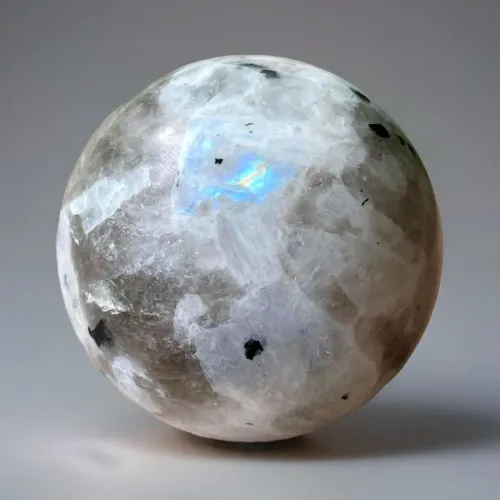
Picture yourself browsing jewelry online, captivated by a moonstone ring's vivid blue flash in photos—**an experience that highlights its primary function as a decorative gem**. When it arrives, the stone shows a softer, pearly glow—much like what happened to Jane, a first-time buyer who learned about adularescence the hard way. Or imagine Maria, who researched **what moonstone does and does not do** in terms of its actual properties after a friend mentioned its stress-relieving potential, wanting facts before wearing it. Whether you're evaluating an heirloom brooch like Alex or fascinated by shifting light like gem-show visitor Liam, you're likely wondering not just about its beauty or symbolism, but geological origins, quality indicators, practical care, and how these factors determine **its real-world use and value**.
What creates moonstone's signature glow?
Why does real moonstone behave differently in various lighting?
How does its formation process affect quality?
What should you check when evaluating a moonstone?
Can you wear it daily without damaging it?
What background research matters before purchasing?
Moonstone's adularescence—a floating light effect—varies significantly based on quality and origin. Authentic pieces exhibit a mobile sheen that shifts across the surface, not static sparkle.
Remember Jane's online shopping experience? The contrast between product photos and reality stems from lighting tricks and mineral composition differences. Higher-grade stones display intense blue sheen when rotated under direct light, caused by light refracting through layered feldspar crystals beneath the surface. Lower-quality pieces show weaker white or colorless glows. Picture holding Liam's gem-show specimen: when he tilted it, the light seemed to roll like mist over water. This "light dance" indicates structural integrity. Natural variations mean no two stones behave identically—an important detail when comparing purchases.
Moonstone forms within cooling igneous rocks as orthoclase and albite feldspars slowly crystallize in layers.
During geological cooling over millions of years, interwoven feldspar sheets develop. When light enters these stacked layers, it scatters to create adularescence—like sunlight hitting mist. Primary deposits in Sri Lanka often yield prized blue varieties due to mineral purity. These formational nuances explain why Alex's inherited brooch showed inconsistent sheen under lamps versus sunlight: the crystal layers reflect differently across angles and light sources. Unlike synthetic imitations, natural stones contain slight imperfections, visible under magnification as pinpoint inclusions where growth paused.
To assess authentic moonstone, observe these geological signatures:
Quality assessment focuses on sheen intensity, distribution, body color, and clarity.
Maria discovered through research that Sri Lankan blue sheen commands premium value due to rarity. When evaluating pieces like Alex's mysterious brooch: - Check sheen visibility in low light – top-grade stones retain glow - Examine translucency – peach or white base colors complement sheen without murkiness - Note color shifts – artificial stones may show uniform hues across angles - Compare luster under sunlight and bulbs – authentic stones change brightness naturally
Watch for overt perfection: synthetic stones display unnaturally even patterns and lack the "watery" depth miners call schiller.
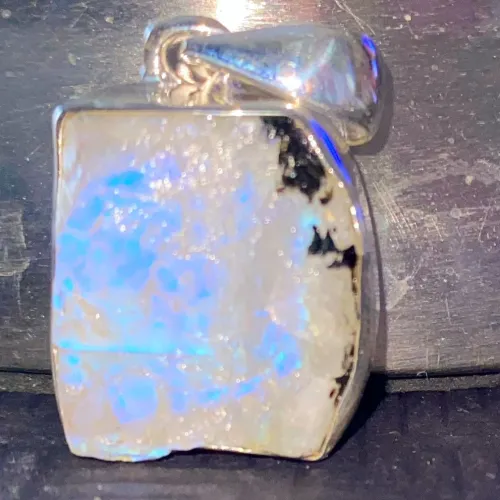
With moderate 6-6.5 hardness, moonstone works in jewelry but requires strategic use. **Understanding what moonstone is good for in daily life means matching its physical properties with appropriate settings.**
Maria chose a protective bezel setting after understanding fracture risks from abrupt impacts—**a key consideration for ensuring its longevity and function as wearable art**. For maintenance: - Clean with lukewarm water and microfiber cloths only - Store moonstone separately from harder gems like diamonds - Wear pendants or earrings more than rings to reduce bump exposure
Many wearers report a calming tactile experience due to its gradual warming against skin—though this subjective effect varies individually and represents a personal, rather than inherent, function of the stone.
Moonstone's symbolism and practical properties invite diverse exploration.
In meditation contexts, practitioners may focus to promote introspective states, leveraging its tactile presence as an anchor. While traditional beliefs connect moonstone with fertility or intuition, scientific evidence focuses solely on mineral properties: - Its June birthstone association derives from watery sheen resembling moonlight - Pronunciation follows "moon-stohn" (not "moons-tone") - Untreated stones show natural phenomena like asterisms or cat's eye under specific cuts Value factors include carat weight (price increases by size and quality), but prioritize visible characteristics over metrics alone.
Moonstone appreciation grows strongest when connecting knowledge to real-world encounters.
Next time you shop jewelry, notice how that blue sheen dances when tilted—the intensity suggests its origin and grade. Before wearing, remember Maria's approach: consider settings protecting delicate edges and prioritize comfortable weight distributions to fully realize **its intended purpose as jewelry**. Handle inherited pieces like Alex did: test under various lights to reveal their true character. Whether drawn to its geothermal origins or luminous beauty, your informed relationship with moonstone begins with observable details, not abstract promises.
Q: What is moonstone for, or what does it do?
A: Moonstone's functions can be categorized as follows:
Q: How does moonstone affect mood scientifically?
A: While traditionally linked with emotional balance, moonstone's influence relates to tactile sensory engagement and personal mindfulness practices rather than proven biochemical changes.
Q: Should I avoid water exposure?
A: Brief contact (handwashing) poses minimal risk, but prolonged immersion may affect untreated specimens; dry thoroughly afterward.
Q: Is it June's only birthstone?
A: Moonstone shares June with pearl and alexandrite, differing by tradition source.


$
