Moonstone is a gemstone from the feldspar family prized for its adularescence – an elusive glow resembling moonlight. Historically linked to intuition and emotional balance across cultures, its visual appeal depends on layered internal structures that scatter light. With a hardness of 6-6.5 on the Mohs scale, it requires careful handling in jewelry applications.
Therefore, when we ask, "What does a moonstone mean?" the answer unfolds on two levels: one grounded in its demonstrable physical properties and geological artistry, and another woven through centuries of human culture and symbolism. Understanding both dimensions is key to a full appreciation of this unique gem.
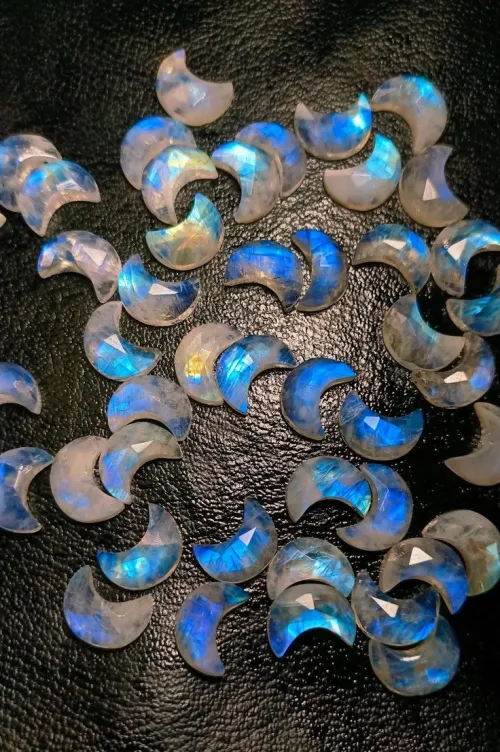
Picture this scenario: You're scrolling through an online marketplace, captivated by a moonstone pendant where the stone seems to hold liquid moonlight. Yet you hesitate, wondering if that ethereal glow translates from screen to reality. Or perhaps a coworker shows you their new moonstone ring, and you notice the blue sheen shifts mysteriously when they move their hand near the window. These everyday experiences with moonstone often trigger three core questions: How does its signature glow actually work? How can I distinguish quality variations? And what practical aspects matter when wearing or buying it? We'll explore those details through tangible observation moments – from jewelry counters to gift unwrappings – while decoding the science behind the enchantment.
1. How does moonstone create its signature glow?
2. What visual traits determine moonstone's authenticity and quality?
3. Where and how does natural moonstone form?
4. How should moonstone be handled and maintained practically?
5. Why does its appearance vary across lighting conditions?
6. What cultural significance has moonstone carried historically?
Moonstone's glow originates from optical interference within its structure, not supernatural properties. When light enters alternating layers of feldspar (typically orthoclase and albite), it diffracts to create the shimmering effect termed adularescence. Think of stacked sheets of glass catching sunlight differently at each angle.
The intensity depends on structural regularity: Finer, more uniform layers create sharper sheens. Quality specimens show a "floating" light effect when rotated under lamps. During formation in pegmatites (coarse-grained igneous rocks), slow cooling allowed mineral crystals to develop parallel layers. This precise arrangement becomes "built-in" optics for light manipulation – explaining why synthetic substitutes often fail to replicate its subtle depth.
Consider walking into a local artisan market where a vendor holds up a moonstone necklace, claiming it encourages calmness. As you examine it, practical verification begins with observation. Notice how the stone behaves near shaded natural light versus electric bulbs? That's your first clue to authenticity.
Natural moonstone demonstrates variable adularescence, while synthetics maintain consistent sparkle. During a video call where a friend wears a moonstone ring, you might notice the glow softens in soft room lighting but ignites near windows. This contrast illustrates adularescence' light-dependence – actual moonstone reacts to environmental changes, whereas glass or plastic imitations stay static. Such situations demonstrate how mundane interactions become experiential learning opportunities.
Practical verification focuses on observable indicators:
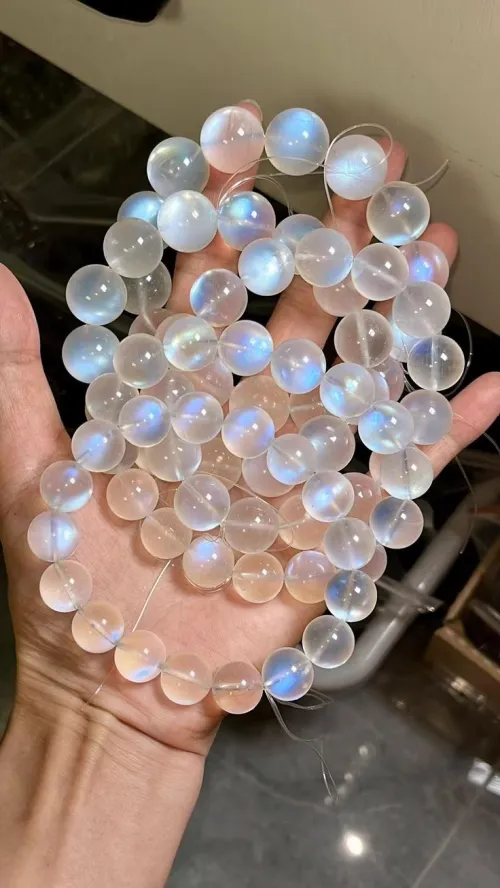
Moonstone forms primarily in igneous rock formations like pegmatites during slow magma cooling cycles. Sri Lanka produces gems with prized blue adularescence, while Indian mines yield peach-toned varieties often seen in bohemian jewelry. Brazilian crystals tend toward translucent gray.
Geography impacts appearance: High-altitude deposits may develop thinner mineral bands, creating more vivid sheen. An ethical concern arises with some rainbow moonstone – though marketed similar, it's actually labradorite. True geological moonstone comes only from feldspar formations. These origin factors explain why museum-grade specimens might showcase stronger optics than mass-market pieces.
Moonstone's 6-6.5 hardness makes it vulnerable to impacts. Remember when that bracelet your sister wore daily got scratched by car keys? That incident stems from crystalline cleavage planes. Protective bezel settings and fabric-lined storage become essential.
Cleaning reveals another practical layer: Unlike diamonds, moonstone shouldn't undergo ultrasonic methods. Instead, lukewarm water with mild detergent gently lifts skin oils. Regular wear often benefits the stone – body heat and friction maintain subtle luster, though perfume or chlorine exposure risks erosion. These considerations transform abstract knowledge into decision-making tools while shopping.
Jewelry historians note moonstone adorned Roman tunics as early as 100 AD. Its cultural significance varies regionally – Asian traditions associate it with lunar deities, while Victorian Europeans interpreted its iridescence as femininity symbols. To understand what moonstone has meant to different cultures is to see it as a historical artifact reflecting human fascination with the moon's mystery. Modern sellers sometimes evoke these contexts, but the tangible, enduring meaning of moonstone for a contemporary wearer should be grounded in its verifiable properties rather than unsubstantiated claims.
When you encounter assertions about its metaphysical properties, redirect evaluation toward testable qualities: Is the sheen orientation-dependent? Does it tolerate moderate pressure? Does its coolness persist? For example, while direct "calming" effects lack scientific backing, the stone's unique, slow visual rhythm can offer a perceptual sense of calm through its observable physics. Such distinctions help separate historical myth from mineralogical reality, allowing you to appreciate its symbolic heritage without conflating it with scientific fact.
Next time you shop for or receive moonstone jewelry, focus on three verifiable aspects: Rotate it in shade seeking that elusive "light roll", inspect settings for protective elements like bezels, and consider if color tones align with known origins like Sri Lankan blues. These steps make you an informed participant rather than a passive observer.
When a store clerk references energy healing or ancient meanings, you can acknowledge the cultural narrative while gently steering the conversation toward the observable physics – the stone's reaction under changing light angles reveals more about its true nature and value than metaphysical promises ever could. Keeping this practical knowledge at your fingertips doesn't diminish moonstone's magic; it grounds your appreciation in its undeniable geological artistry and enriches your understanding of its full meaning.
Q: Are moonstone's spiritual meanings scientifically proven?
A: While historical cultures ascribed various significances to moonstone, modern geology focuses on its demonstrable optical phenomena. Any personal or emotional resonance is typically related to its visually soothing properties and cultural associations, rather than any scientifically verified inherent powers.
Q: How does moonstone differ from opal?
A: Unlike opal's "play of color" caused by silica spheres diffracting light, moonstone displays a directional sheen (adularescence) from structural interference within feldspar layers. Moonstones also demonstrate greater toughness despite similar hardness ratings on the Mohs scale.
Q: Can you wear moonstone daily?
A: With prudent care, yes. Protective settings (like bezels) and avoiding impact-prone activities significantly improve longevity. Rings endure daily wear better when mounted with low profiles, while pendants and earrings generally present lower risk of damage.


$
